Derby & District · demonstration league
Fictional teams and players. A season in progress since July 2026.
The Break & The 3-Point System
Under International 8-Ball Rules, a legal break requires accumulating at least 3 cumulative points across potted object balls and balls crossing the imaginary centre line. Explore the visual table diagrams, decision rules, and interactive match calculator below.
Decides Break
Winner chooses who breaks Frame 1. Alternating break format applies thereafter.
Minimum Required
1 pt per potted ball + 1 pt per ball completely passing the imaginary centre line.
Groups Not Decided
Potted balls from the break are disregarded. Groups are only decided by the first legal pot in open play.
No Golden Break
If the 8-ball is potted off the break, it is always re-spotted. No instant win or loss.
Opponent Option
If the break fails the 3-point test, opponent may choose to break themselves or give it back.
Lag for Break Format: How the Break is Decided
The winner of the lag decides who breaks first in Frame 1, with an alternating break format in all subsequent frames.
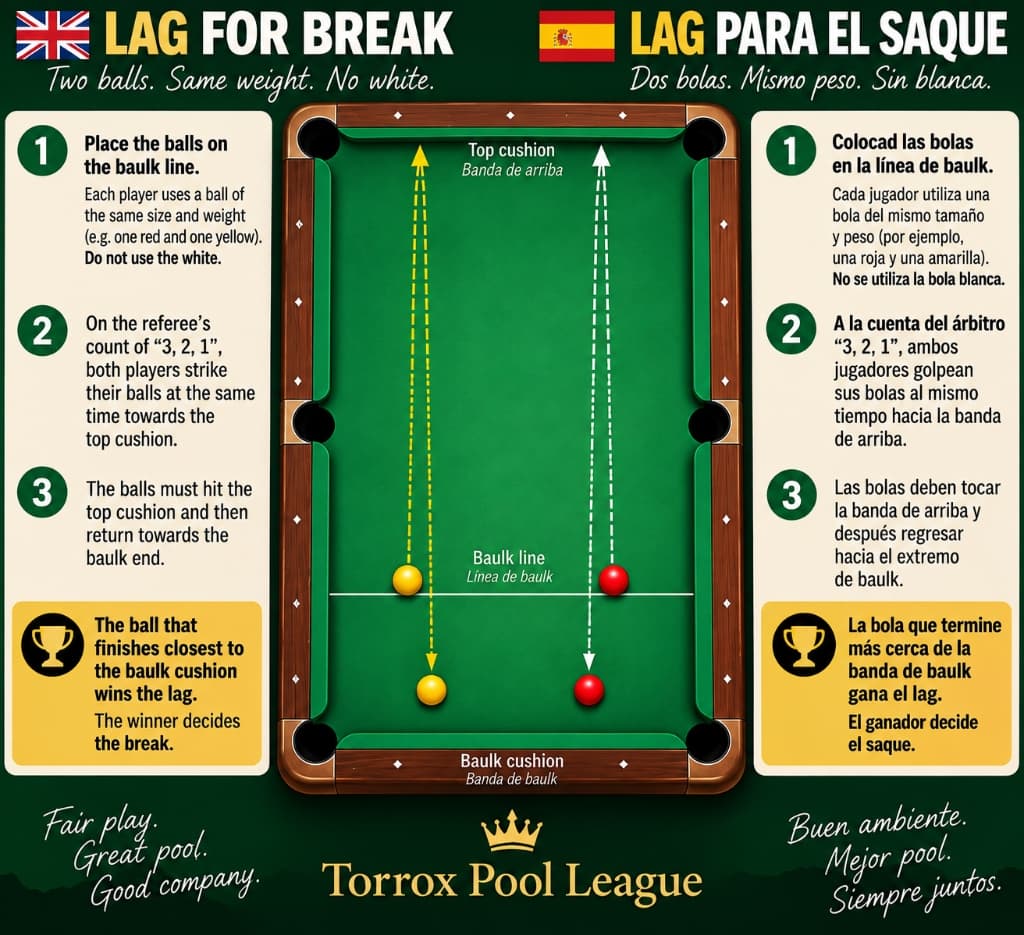
Place the balls on the baulk line
Each player uses a ball of the same size and weight (e.g. one red and one yellow). Do not use the white.
On the referee’s count of "3, 2, 1"
Both players strike their balls at the same time towards the top cushion.
Hit top cushion and return towards baulk
The balls must hit the top cushion and then return towards the baulk end.
Closest to the baulk cushion wins the lag
The ball that finishes closest to the baulk cushion wins the lag. The winner decides the break (may break or hand the break to the opponent in Frame 1). An alternating break format applies thereafter.
A player automatically loses the lag if their ball commits any of the following:
- •Crosses into the opponent’s half of the table.
- •Fails to contact the top cushion.
- •Drops into any pocket.
- •Hits a side cushion.
- •Jumps off the table.
- •Comes to rest within the corner pocket drop area.
- •The player commits any standard foul (e.g. double hit).
Both players must lag again from the baulk line in any of the following circumstances:
- 1.Both players commit a lag foul simultaneously.
- 2.The referee is unable to decide which ball is closest to the bottom cushion.
- 3.One player’s ball strikes the top cushion before the other player’s ball is struck.
Interactive Match Break Calculator
Tap the outcomes from your break to instantly verify if it was legal or requires a re-rack.
Whole ball must have crossed the imaginary middle pocket line.
Fewer than 3 cumulative points scored. Mandatory re-rack (Rule 4g).
1.All 15 balls must be re-racked (Rule 4g).
2.Opponent's Option: The incoming player decides whether to break themselves OR give the break back to the original breaker.
Official Visual Diagrams
Technical illustrations of the table layout, centre line rulings, and ball placements.
Table Layout & The Break Area (Rule 2 & 4e)
Official Triangle Rack Formation & Ball Sequence (Rule 2 & 3)
Official Racking Sequence (Apex to Base):
- 8-Ball on the Spot: The 8-ball must sit in row 3, directly centered over the eight-ball spot (Rule 2).
- Different Corner Balls: The two rear corner balls MUST be different colours (one Red, one Yellow).
- Total Count: Exactly 7 Reds, 7 Yellows, and 1 Black = 15 balls racked tightly with zero gaps.
When Does an Object Ball Count as "Passed"?
Under Rule 4f, an unpotted object ball only counts towards the 3 points if the entire ball has crossed the imaginary centre line. If even a sliver of the ball is over or touching the line, it is not counted.
⚠️ No Double Counting: If a ball crosses the centre line, strikes the baulk cushion, and bounces back over the centre line, it still counts as only 1 point. If a ball crosses the line and then falls into a pocket, it counts as 1 point (not 2).
Cue Ball In-Off vs Off the Table off the Break (Rule 4j)
Cue Ball Goes "In-Off"
The break was legal (3+ points), but the cue ball fell into a pocket.
The cue ball must be placed behind the break line, but may be played in ANY direction (forwards or backwards).
* Note: This is the ONLY instance in International Rules where ball in hand is restricted to baulk.
Cue Ball Leaves Playing Surface
The cue ball flies off the table, hits a floor/chair, and does not return by its own means.
The player may place the cue ball anywhere on the entire table surface without restriction.
* Standard foul penalty applies as per Rule 6l(1) and 6e(15).
Eight-Ball Potted off the Break (Rule 4i)
Primary Location
Placed with its centre point directly on the Eight-Ball Spot.
Secondary Line (Top Cushion)
If the spot is covered, place as near as possible on the direct line between the spot and the centre of the top cushion (without touching other balls).
Tertiary Line (Bottom Cushion)
If the top line is completely blocked, place as near as possible in a direct line towards the centre of the bottom cushion.
• If the 8-ball was the ONLY ball potted on a legal break: Control of the table passes to the incoming player. The table is open.
• If the 8-ball was potted together with other object balls on a legal break: The original breaker continues their visit at the table. The table is open.
Captains & Referees Break FAQ
Common match-night break scenarios under International Rules.
Q: Can you win the frame on the break? ("Golden Break")
No. In International Rules, potting the 8-ball off the break never wins the frame. The 8-ball is always re-spotted and play continues.
Q: Can you lose the frame on the break? ("Golden Duck")
No. Even if the 8-ball is potted and the cue ball goes in-off on the break, it is NOT loss of frame. The 8-ball is re-spotted, and the incoming player receives ball in hand from baulk.
Q: Does the cue ball count towards the 3 points?
No. Only object balls (reds, yellows, and the 8-ball) count towards the 3 cumulative break points. The white never counts.
Q: What are the opponent's options after an illegal break?
Under Rule 4g, failure to make a legal break results in a mandatory re-rack. The opponent has the choice to: (a) Break the balls themselves, OR (b) Hand the break back to the original breaker.
Q: Are groups decided if 3 reds are potted on the break?
No. The table is ALWAYS open after the break (Rule 4h). Potted balls on the break are disregarded. Groups are only chosen on the first legal pot in normal open play.
Q: After a break in-off, can you shoot backwards?
Yes! Rule 4j(1) specifically states the cue ball is played "from baulk, in any direction." You are not required to shoot past the baulk line.
Q: How is the break decided, and does the winner break every frame?
The break in Frame 1 is decided by a "Lag for Break" (Rule 4a). The winner of the lag decides whether to break or hand the break to their opponent in Frame 1. In all subsequent frames, the break alternates strictly between players/teams regardless of who won the previous frame (alternating break format).
Q: Can players lag using one white cue ball and one coloured ball?
No! Rule 4b(1) and the official Torrox Pool League format strictly require two object balls of identical size and weight (e.g. one red and one yellow). The white cue ball is strictly prohibited against a coloured ball because cue balls differ in weight, which creates an unfair advantage.